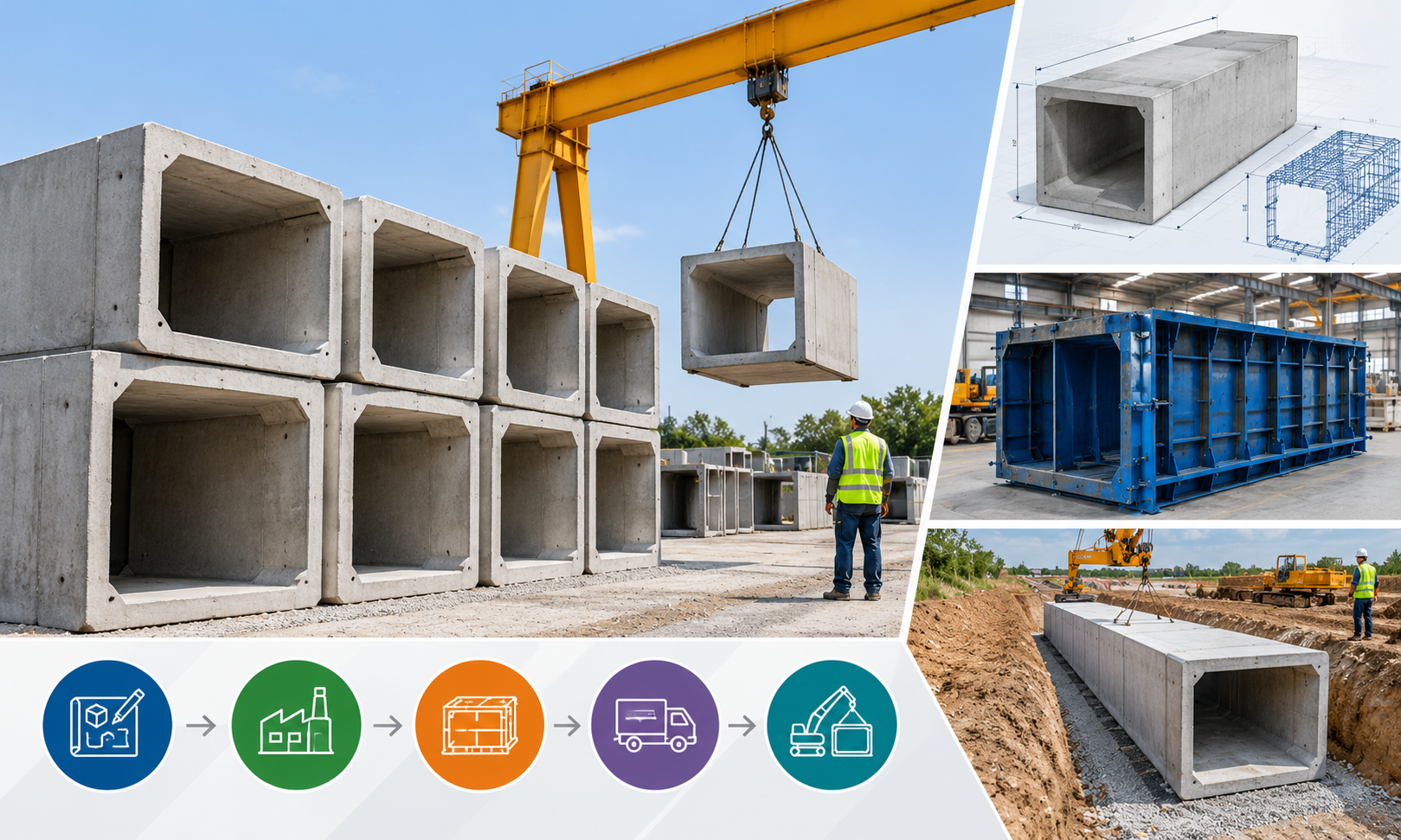
Precast Concrete Box Culvert: Complete Design, Manufacturing, Mould & Installation Guide
Precast concrete box culverts are widely used in road infrastructure, drainage networks, irrigation works, utility crossings, underpasses and other civil engineering applications where a strong, controlled and simple installable concrete structure is required.
Unlike a traditional cast-in-situ culvert, a precast box culvert is manufactured under controlled production conditions and transported to the project site as a finished structural element. This can reduce the amount of formwork, on-site fixing and concrete work required at site and can significantly accelerate installation when the project has been properly designed and planned.
But there is an important point that is often overlooked:
The performance of a precast box culvert does not begin at the construction site. It begins how the Box Culvert is being Manufactured? What Material is used there? How is it being designed?
This guide explains the complete process – from box culvert design and mould engineering to manufacturing and installation.
What Is a Precast Concrete Box Culvert?
A precast concrete box culvert is a reinforced concrete structure manufactured in a controlled casting environment and subsequently transported and installed at the project location.
A typical box section consists of:
- Top slab
- Bottom slab
- Side walls
- Internal clear opening
- Reinforcement
- Jointing arrangement between adjacent sections
The opening allows water, drainage, utilities, pedestrians or other permitted traffic to pass through, while the reinforced concrete section is designed to withstand the structural and environmental loads applicable to the project.
Precast box culverts can be manufactured as single-cell or multi-cell configurations and can be produced in standard or project-specific dimensions.
For Indian highway and cross-drainage applications, Guidelines for Construction of Precast Concrete Segmental Box Culverts, provides guidance covering specifications, construction methodology, quality management, safety and maintenance.
How Does a Box Culvert Work?
A box culvert has two jobs to perform simultaneously.
1. Hydraulic function
The opening provides a controlled passage for:
- Stormwater
- Natural watercourses
- Irrigation flows
- Drainage discharge
- Other project-specific flows
The size and configuration of the opening therefore need to be considered in relation to the required hydraulic capacity and site conditions.
2. Structural function
The concrete box must also withstand the loads imposed on it.
Depending on the project, these can include:
- Self-weight
- Earth pressure
- Soil surcharge
- Road traffic loads
- Construction loads
- Water-related forces
- Other project-specific loads
This is why selecting a box culvert simply by looking at its opening size is not sufficient.
The hydraulic requirement determines how much water needs to pass. The structural design determines whether the box can safely carry the loads around it. Both have to work together.
Main Components of a Precast Box Culvert
A typical precast box culvert consists of several important elements.
Top Slab
The top slab transfers loads from the soil, road, pavement and other superimposed loads into the side walls.
Side Walls
The side walls transfer structural forces between the top and bottom portions of the box and interact with the surrounding soil.
Bottom Slab
The bottom slab transfers the structural load to the prepared foundation or bedding.
Clear Opening
The clear opening is the usable internal space through which water, people, utilities or other permitted traffic may pass.
Reinforcement
Reinforcement is designed according to the structural requirements of the project.
Joints
Where individual precast sections are installed sequentially, joints connect adjacent units and may require specific sealing or jointing systems depending on project requirements.
Types of Precast Concrete Box Culverts
1. Single-Cell Box Culvert
A single-cell culvert contains one continuous opening. It is commonly considered where one opening can provide the required hydraulic or functional capacity.
2. Multi-Cell Box Culvert
A multi-cell arrangement consists of two or more openings. This can be considered where a larger overall waterway or functional opening is required and site conditions make a multi-cell arrangement appropriate.
3. Segmental Box Culvert
Individual precast units are manufactured, transported and installed one after another to create the required overall length.
4. Custom Box Culvert
Precast box culverts do not necessarily have to follow one universal dimension. The box can be engineered according to:
- Required clear opening
- Structural loads
- Site conditions
- Hydraulic requirements
- Available cover
- Transportation limitations
- Installation methodology
- Production capability
Box Culvert vs Pipe Culvert: Which Is Better?
The correct choice depends on the hydraulic requirement, available space, loading, soil conditions, installation constraints and project economics.
| Factor | Box Culvert | Pipe Culvert |
| Cross-section | Rectangular | Circular |
| Opening | Wide and generally shallow | Circular |
| Large hydraulic openings | Often suitable | May require multiple pipes |
| Shallow-depth situations | Can be advantageous | Project dependent |
| Multi-cell configuration | Possible | Multiple parallel pipes |
| Underpass applications | Can be adapted for suitable applications | More limited |
| Custom dimensions | Possible | Possible |
| Installation | Requires suitable lifting equipment | Depends on pipe size |
| Best solution | Project/design dependent | Project/design dependent |
The important question is therefore not:
“Is a box culvert better than a pipe?”
It is:
“Which cross-section provides the required hydraulic and structural performance within the site’s physical and economic constraints?”
Where Are Precast Box Culverts Used?
Precast box culverts have applications well beyond Traditional drainage systems.
Road & Highway Infrastructure
- Cross-drainage works
- Road drainage
- Highway crossings
- Stormwater channels
- Under-road passages
Urban Infrastructure
- Stormwater management
- Drainage networks
- Utility corridors
- Service passages
- Pedestrian crossings
Irrigation & Water Management
- Canal crossings
- Watercourses
- Drainage channels
- Agricultural infrastructure
Industrial Infrastructure
- Plant drainage
- Utility crossings
- Service corridors
- Water-management infrastructure
Transportation Infrastructure
- Road underpasses
- Pedestrian passages
- Cattle passes
- Service tunnels
- Other project-specific crossings
What are Box Culvert Dimensions?
One of the most common misunderstandings is that each Box Culvert size is different as per the requirements, which is true to some extent. But, systems like Nova Plastic Formworks can reduce this dependency on multiple sizes, because we have a Modular Formwork System. This means one system can form endless possibilities. Though we have standard sizes which can fit various requirements for your project developments, even if your project needs complex sizes, we can also provide them.
Box Culvert Design: Hydraulic + Structural Considerations
A box culvert should not be treated simply as a concrete “drain.” Two design questions need to be answered.
Hydraulic question:
How much flow must pass through the structure?
This involves considerations such as:
- Design discharge
- Waterway
- Inlet and outlet conditions
- Scour
- Flow characteristics
- Site levels
- Required clearances
Structural question:
What loads must the box safely withstand?
This can include:
- Earth load
- Traffic/live load
- Dead load
- Construction load
- Earth pressure
- Other project-specific forces
Indian Standards & Guidelines for Precast Box Culverts
For Indian infrastructure projects, the applicable standards should be established during project design. Guidelines for Construction of Precast Concrete Segmental Box Culverts covers:
- Specifications
- Design considerations
- Construction methodology
- Quality management
- Safety
- Handling
- Installation
- Maintenance
It also addresses the need for project information such as box size, laying length, burial depth, design live load, joint type, fittings, material testing and joining materials.
Important: The final design should always be checked against the current applicable standards and approved by the project’s qualified structural/hydraulic design professionals.
How Are Precast Concrete Box Culverts Manufactured?
A typical production sequence can include:
Mould preparation → Reinforcement placement → Mould inspection → Concrete placement → Compaction → Curing → Demoulding → Inspection → Storage → Transportation → Installation
A defect introduced during casting can become difficult or expensive to correct after the unit has reached the site.
What Is a Box Culvert Mould?
A box culvert mould is the engineered formwork system used to create the geometry of the precast concrete box.
It determines the basic shape and dimensional accuracy of the finished component.
A mould generally consists of:
- External side forms
- Internal core
- Base/forming surface
- Locking system
- Reinforcement clearance provisions
- Lifting/demoulding provisions
- Access and handling arrangements
For repetitive precast production, the mould is not merely a temporary container for concrete. It is a production tool. Its design affects:
- Cycle time
- Dimensional consistency
- Surface finish
- Demoulding
- Labour requirement
- Repeatability
- Maintenance
- Production output
The Part Most People Miss: The Mould Is Part of the Product
Two manufacturers can use the same concrete mix and reinforcement design and still produce very different manufacturing results. Why? Because the mould influences:
Geometry → reinforcement clearance → concrete flow → compaction → demoulding → surface quality → dimensional repeatability
This is particularly important for box culverts because the internal core has to be removed without damaging the freshly cast section. A mould therefore has to be designed not only for the final dimensions but also for the manufacturing sequence.
A Real Manufacturing Problem: Demoulding Is Not an Afterthought
This is one of the most important practical considerations in box culvert mould design. The internal core occupies the opening of the box during casting.
After the concrete reaches the required release condition, that core has to come out.
If the geometry, taper, clearances, lifting arrangements or demoulding sequence have not been properly considered, the core can interfere with the concrete during extraction.
That can lead to:
- Damaged corners
- Surface marks
- Chipping
- Cracking
- Increased demoulding time
- Additional repair work
- Slower production cycles
Therefore, the question is not simply “Can the mould make this box?”
The better question is:
“Can the mould repeatedly make this box and release it safely within the intended production cycle?”
That distinction is critical when designing a production mould.
Another Reality: Reinforcement and Mould Design Must Be Considered Together
A mould drawing may look perfect on paper.
The real challenge begins when the reinforcement cage enters the mould.
Reinforcement congestion can affect:
- Available cover
- Concrete flow
- Vibrator access
- Placement sequence
- Embedded components
- Demoulding
- Corner quality
This means the mould designer, reinforcement designer and precast producer should not work as completely separate functions.
The best mould is designed around the actual manufacturing process – not just around the final external dimensions.
Concrete Placement: Where Good Moulds Can Still Fail
A precise mould cannot compensate for poor concrete production or placement practices.
Concrete needs to reach all required areas of the section and be adequately compacted without creating segregation or defects.
Particular attention may be required around:
- Corners
- Reinforcement congestion
- Internal core areas
- Lifting inserts
- Embedded items
- Thin sections
The production process should therefore consider concrete workability, placement sequence, compaction method and curing requirements.
The Hidden Stage: Lifting and Handling
The box can be perfectly cast and still be damaged during handling.
A precast box experiences different forces during:
Demoulding → Lifting → Storage → Loading → Transportation → Unloading → Installation
These are not necessarily the same forces considered during its final service condition. This is why lifting points, lifting methods, equipment and handling procedures need to be considered as part of the overall system.
Transportation Can Influence Mould Design
This is another practical consideration that is frequently overlooked during the early design stage. A technically possible box is not automatically a logistically practical box. Before finalizing the production procedures, the manufacturer and project team should consider:
- Unit dimensions
- Unit weight
- Transport route
- Vehicle capacity
- Site access
- Crane capacity
- Turning radius
- Storage space
- Unloading location
- Installation sequence
In other words:
Design → mould → production → transport → installation
should be treated as one connected chain.
How Are Precast Box Culverts Installed?
A typical installation sequence includes:
Step 1: Site investigation and setting out
Confirm the approved alignment, levels, invert elevation and excavation requirements.
Step 2: Excavation
Prepare the excavation according to the approved design and site conditions.
Step 3: Foundation preparation
Remove unsuitable material where required and prepare the specified foundation/bedding.
Step 4: Bedding preparation
Create a level and properly prepared bearing surface.
Step 5: Place the first box
The first unit is extremely important. It establishes the line and grade for the units that follow.
Step 6: Install subsequent units
Each unit is carefully lifted, positioned and aligned with the previous section.
Step 7: Jointing
Apply the specified jointing/sealing system.
Step 8: Backfilling
Backfill progressively using the specified material and compaction procedure.
Step 9: End treatments
Where required, construct headwalls, wing walls, aprons, protection works or other associated structures.
Installation guidance consistently emphasizes bedding, alignment, jointing and controlled backfilling as critical stages.
Common Box Culvert Challenges
Many problems that appear at the project site actually originate much earlier.
| Problem | Possible underlying cause |
| Dimensional mismatch | Mould or production control |
| Damaged corners | Demoulding/handling |
| Difficult joint closure | Alignment or bedding |
| Water leakage at joints | Incorrect joint preparation/sealing |
| Uneven settlement | Foundation/bedding |
| Surface defects | Mould, concrete, compaction or curing |
| Installation delays | Poor logistics planning |
| Cracking during handling | Inadequate handling/release condition |
| Slow production | Mould cycle/design limitations |
| Reinforcement clashes | Poor coordination between cage and mould |
| Difficult demoulding | Core/geometry/clearance issue |
This is why a box culvert should be treated as a system, not just a concrete component.
Precast Box Culvert vs Cast-in-Situ Box Culvert
| Factor | Precast | Cast-in-Situ |
| Manufacturing environment | Controlled factory environment | Project site |
| Formwork | Reusable production mould | Site formwork |
| Site concrete work | Reduced | Higher |
| Production repeatability | High when mould/process is controlled | More site dependent |
| Construction speed | Can be faster | Usually more site-intensive |
| Weather exposure during casting | Lower | Higher |
| Transportation | Required | Not required for finished unit |
| Crane requirement | Usually required | Depends on construction method |
| Customization | High but mould-dependent | Very high |
| Best application | Repetitive/accelerated projects and suitable site conditions | Highly site-specific structures |
What Determines the Cost of a Precast Box Culvert?
There is no meaningful single “box culvert price” without knowing the project requirements.
Cost can depend on:
- Clear opening
- Overall dimensions
- Concrete grade
- Reinforcement quantity
- Wall and slab thickness
- Unit length
- Number of units
- Number of cells
- Jointing system
- Mould investment
- Production volume
- Transportation distance
- Crane requirement
- Foundation preparation
- Site access
- Installation methodology
For a mould manufacturer, another important distinction exists:
The cheapest mould is not necessarily the lowest-cost mould.
A mould with a lower purchase price but slow demoulding, high maintenance, poor repeatability or excessive labour can increase the cost of every casting cycle.
The right comparison is therefore based on total production economics, not only mould purchase price.
The Nova Approach to Box Culvert Mould Engineering
At Nova Formworks, the focus is not simply on making a mould that matches a drawing. The objective is to develop a mould that works as part of the precast production process. The engineering conversation should therefore cover:
Box geometry → reinforcement → mould configuration → concrete placement → compaction → demoulding → handling → storage → transportation → installation
This approach helps identify manufacturing constraints before they become production problems. For customized box culvert mould requirements, project-specific parameters should be evaluated before finalizing the mould design.
Why Mould Repeatability Matters
One good casting does not prove that a mould is successful.
A production mould has to produce the required geometry repeatedly.
That means asking:
- Does the mould maintain alignment?
- Does the internal core remain accurate?
- Does the surface condition remain consistent?
- Is demoulding predictable?
- Are locking mechanisms reliable?
- Can cleaning be performed efficiently?
- Can worn components be maintained or replaced?
- Does the production cycle remain practical?
Repeatability is one of the most important differences between a fabrication fixture and a true production mould.
Quality Control: What Should Be Checked?
Quality control should extend beyond the final visual appearance.
Depending on project specifications, checks may include:
Raw materials
- Cementitious materials
- Aggregates
- Water
- Admixtures
- Reinforcement
Mould
- Dimensions
- Alignment
- Cleanliness
- Release condition
- Locking system
Reinforcement
- Bar diameter
- Spacing
- Cover
- Cage dimensions
- Embedded components
Concrete
- Mix requirements
- Workability
- Placement
- Compaction
- Strength
Finished unit
- Dimensions
- Surface condition
- Cracks/damage
- Lifting points
- Identification
- Orientation
- Storage condition
A Better Way to Think About Precast Box Culverts
A precast box culvert is not simply:
Concrete + Reinforcement + Mould
It is a chain:
Design
↓
Hydraulic requirement
↓
Structural requirement
↓
Mould engineering
↓
Reinforcement
↓
Concrete production
↓
Compaction & curing
↓
Demoulding
↓
Handling
↓
Transportation
↓
Foundation & bedding
↓
Installation
↓
Jointing
↓
Backfilling
↓
Final performance
A weakness at any stage can affect the final result.
That is why the best precast solutions are designed by considering the complete lifecycle rather than treating each stage independently.
FAQs About Precast Box Culverts
What is a precast concrete box culvert?
A precast concrete box culvert is a reinforced concrete box section manufactured in a controlled production environment and installed at a project site to provide a passage for water, drainage, utilities, pedestrians or other approved applications.
What is the difference between a box culvert and a pipe culvert?
A box culvert has a rectangular opening, while a pipe culvert generally has a circular cross-section. The appropriate option depends on hydraulic, structural, site and economic requirements.
Are precast box culverts stronger than cast-in-situ culverts?
Strength is determined by the design, materials, reinforcement, manufacturing quality and installation conditions. Precast construction can provide controlled manufacturing conditions, but the final performance still depends on proper design and installation.
What are the standard dimensions of a box culvert?
There is no single universal dimension. Box culverts can be designed in different sizes according to hydraulic requirements, structural loads, site conditions and project specifications.
What standards are used for box culverts in India?
For precast concrete segmental box culverts, IRC:122-2017 is an important Indian guideline. Other applicable IRC and IS provisions depend on the specific project and application.
How are precast box culverts installed?
Installation generally involves excavation, foundation/bedding preparation, lifting and positioning the first box, placing subsequent units, jointing, alignment, backfilling and construction of required end treatments.
Why is the first box culvert important during installation?
The first unit establishes the reference for line and grade. Incorrect positioning of the first unit can make alignment of subsequent units more difficult.
What is a box culvert mould?
A box culvert mould is the engineered formwork used to cast the precast concrete box to the required dimensions and geometry.
Can box culvert moulds be customized?
Yes. Moulds can be engineered around project-specific box dimensions, production requirements, reinforcement arrangements and demoulding methods.
What affects the cost of a box culvert mould?
Major factors include dimensions, mould configuration, material, production volume, demoulding method, reinforcement arrangement, automation requirements, customization and expected production cycle.
What causes damage during box culvert production?
Potential causes include premature handling, poor demoulding, inadequate support, reinforcement interference, improper concrete placement, poor compaction, insufficient curing or incorrect lifting procedures.
Is a precast box culvert suitable for every project?
No. The choice should be based on hydraulic design, structural requirements, soil conditions, site access, transportation, installation requirements and project economics.
Conclusion
Precast concrete box culverts offer an efficient solution for many drainage, road, utility, underpass and infrastructure applications. But the quality of the final structure depends on much more than the concrete itself. The process begins with the design of the box.
Then comes the mould.
Then reinforcement, concrete placement, compaction, curing, demoulding, lifting, transportation, foundation preparation, alignment, jointing and backfilling.
The better these stages are connected, the more predictable the final result becomes.
For precast manufacturers, this makes the box culvert mould a critical part of the production system – not merely a tool used to hold concrete.
Nova Formworks develops customized formwork and mould solutions for precast concrete applications, with the focus on practical production requirements, repeatability, dimensional accuracy and project-specific engineering.
Looking for a Box Culvert Mould for Your Precast Production?
Share your:
- Required box dimensions
- Clear opening
- Wall/slab thickness
- Production quantity
- Reinforcement arrangement
- Required mould configuration
- Project location
- Desired production cycle
with Nova Formworks to discuss a project-specific solution.