
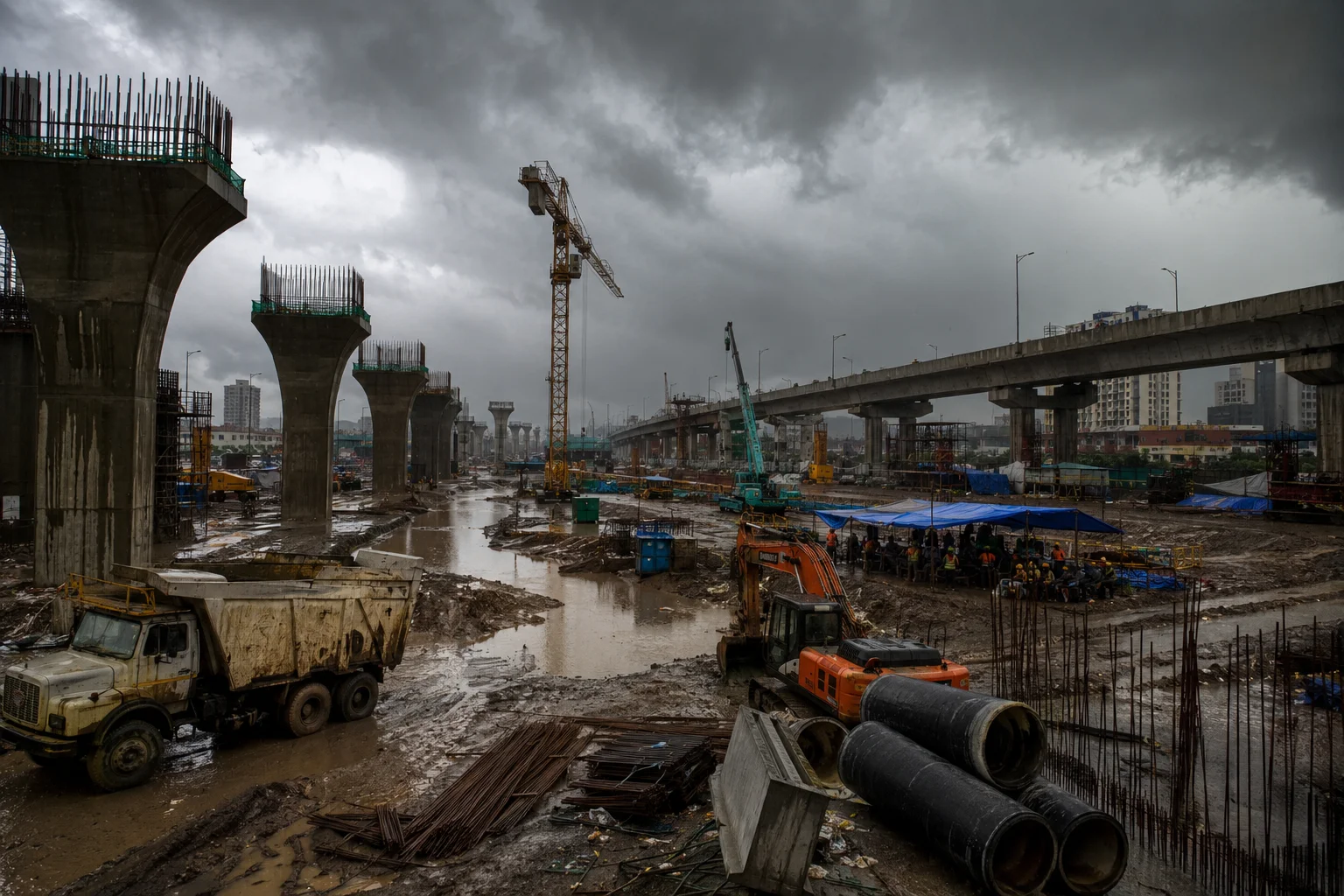
Every year between June and September, India’s construction industry collectively loses billions in productive site-hours – not because of material shortages or budget cuts. Because the south-west monsoon disrupts the assumptions on which most infrastructure project schedules are built. To understand this challenge better, it’s important to look at how monsoon conditions impact traditional formwork systems. We’ll explore how Nova Formworks’ reusable plastic formwork solutions are helping infrastructure and construction projects stay on schedule even irrespective of weather.
How can Monsoon Disrupts your Construction Project Schedule?
When we talk about monsoon delays, it’s not just about rain stopping work for a few hours. Heavy rainfall can affect site access, material handling, labour productivity, concrete quality, and construction schedules.
- Labour Non-Attendance: A large skilled and semi-skilled labour is migrant. The monsoon coincides with the Kharif agricultural season back home, which pulls a meaningful percentage of this workforce off-site – sometimes permanently for that season.
- Equipment Access and Mobility: Most infrastructure sites involve crane-dependent formwork erection. During heavy rainfall, Wind loads creates crane operation disturbance. On sites where every formwork cycle begins with a crane lift, a single day of crane downtime is a day of zero casting output – regardless of what the rest of the crew could theoretically do.
- Concrete Curing and Quality Control: Monsoon conditions affect concrete in two opposing ways: excess water in the mix from rain ingress weakens the pour if uncovered, while high humidity can actually extend curing time unpredictably.
- Material Degradation and Storage: Plywood-based shuttering – still the dominant formwork material on a very large percentage of Indian sites – absorbs moisture and begins to delaminate within a single monsoon season.
- Site Access and Ground Conditions: Waterlogged access roads delay material deliveries. On drainage and culvert projects specifically, rising water tables can force temporary suspensions of box-casting work.
Key Insight
Each of these five disruption mechanisms compounds the others. A two-day crane stoppage, combined with a 25% labour shortfall and an extended stripping wait time, doesn’t add up to a 4–5 day delay. On a tightly sequenced multi-pour programme, it can cascade into 10–14 days of lost output on a single structure.
Infrastructure Sectors Most Exposed to Monsoon Delay
| Sector | Monsoon Exposure | Primary Risk | Deadline Sensitivity |
| Metro / Elevated Corridor | Medium – work continues but crane ops disrupted | Cycle slippage on pier/column casting | Very High – fixed political deadlines |
| National Highway / NHAI Bridges | High – open sites, drainage works near water table | Falsework instability, box culvert flooding | Very High – completion milestones tied to NH network |
| Urban Drainage / Box Culverts | Very High – directly intersects with water ingress | Work suspension during peak flows | High – Smart Cities / AMRUT programme timelines |
| Industrial / Commercial EPC | Medium – partially covered sites | Labour attendance, crane access | High – fixed plant-commissioning dates |
| Government Buildings (PWD) | Medium–High – exposed reinforced concrete frames | Plywood degradation, curing quality | Medium – project varies; penalties for delay |
What Monsoon Delays can actually Costs?
- Daily overhead cost – Most infrastructure sites carry a fixed daily cost: site office, equipment hire, security, power, insurance, and management salaries. On a mid-size infrastructure project, this overhead can range from ₹2–8 lakhs per idle day depending on scale.
- Labour cost for standby crews – Workers retained on-site during rain stoppages must typically be paid idle-day wages under contract terms. A crew of 80 workers at ₹600/day adds -₹48,000 in direct labour cost per idle day – before any equipment cost.
- Rescheduling and recovery costs – Recovering a delayed programme usually requires overtime, additional crews, or equipment mobilisation at premium rates. A 10-day delay in monsoon rarely costs 10 days of overhead; the recovery phase adds 30–50% on top.
- Penalty clauses – Government infrastructure contracts increasingly carry liquidated damages (LD) clauses: typically 0.1–0.5% of contract value per week of delay beyond the scheduled completion date. On a ₹100 crore NHAI subcontract, this is ₹10–50 lakhs per delayed week.
- Material replacement – Mid-project plywood and timber shuttering replacement, forced by monsoon degradation, adds direct material cost outside the original BOQ. On large RCC structures, this can reach ₹5–15 lakhs per delayed monsoon season.
Real Example
A highway bridge substructure project with a ₹25 crore contract value, a 180-day programme, and a 0.2% per week LD clause. A 15-day monsoon slippage carries approximately ₹5 lakh in LD exposure, ₹90 lakh in extended overhead (assuming ₹6 lakh/day), and ₹8–10 lakh in recovery and overtime costs. Total exposure on a ’15-day delay’: ₹1 crore or more. This is not unusual – it is the industry norm on inadequately planned monsoon-season programmes.
Where the Formwork Decision Fits In
Of the five disruption mechanisms identified in Section 1, four of them are directly influenced by the formwork system a site uses:
- Labour dependency – Systems designed to be handled by a smaller, less specialised crew maintain output even when attendance drops 20–30%.
- Crane dependency – Assembly & dis-assembly are not affected as cranes aren’t accessibly due to rain & wind. This single factor can mean the difference between a delayed cycle and a completed one.
- Curing and stripping time – Formwork panels that deliver a consistent, dimensionally stable surface allow engineers to make stripping decisions based on actual concrete strength data rather than conservative visual inspection of an uneven surface. Faster, more confident stripping decisions shorten cycle times.
- Material degradation – Non-absorbent, weatherproof panels eliminate the monsoon plywood problem entirely.
Nova‘s patented plastic formwork system was specifically engineered around these failure modes. It don’t need heavy lifting, delivers a consistent smooth-finish surface across its 150+ reuse cycle lifespan, and does not absorb water.
Key Takeaways for Infrastructure and Government Contractors
- The south-west monsoon creates five distinct disruption mechanisms on infrastructure sites: labour non-attendance, crane/equipment restrictions, concrete curing compression, material degradation, and access/ground condition problems. Each requires a specific response.
- When overhead, LD exposure, and recovery costs are combined, 15 days delay to a government infra contract can exceed 1 crore. This is not an edge case – it is the sector average.
- Four of the five monsoon disruption mechanisms are directly influenced by the formwork system a site uses. Crane-free, weather-resistant, reusable modular systems reduce monsoon vulnerability at the point in the project where the most controllable decisions are made.
- Good monsoon planning happens in April and May, not July. Contractors who have not yet reviewed their programme, formwork system, labour plan, and casting sequence for monsoon risk should do so now.
- Government project contractors carry the highest financial exposure per week of delay and work on the most weather-exposed site types. For this group, monsoon readiness is not a best-practice recommendation – it is a contract-protection necessity.
Is Your Site Ready for Monsoon Season?
Connect with us for weather-resistant, lightweight, modular, reusable formwork – a practical, site-ready audit system for infrastructure, drainage, metro, and government project teams.
FAQs
1. When does the monsoon season begin and end for construction planning purposes in India?
The south-west monsoon typically arrives over the Kerala coast in the first week of June and covers most of peninsular and central India by late June or early July. It withdraws progressively from north-west India through September, with the season largely complete by early October across most of the country.
2. What causes the biggest construction delays during monsoon – rainfall or something else?
Rainfall is the trigger, but it is rarely the direct cause of delay. The primary delay drivers are: (1) labour non-attendance, as migrant workers return for the Kharif agricultural season; (2) equipment downtime, particularly crane stoppages due to high wind or restricted visibility; (3) extended concrete stripping wait-times as site engineers take conservative decisions under uncertain curing conditions; and (4) material failure, particularly plywood shuttering that swells, warps, or delaminates after water absorption.
3. Does using plastic formwork instead of plywood actually reduce monsoon delays?
It eliminates several specific delay mechanisms. Plastic formwork panels do not absorb water, so they do not warp, swell, or delaminate during monsoon exposure. This removes the mid-project plywood replacement cost and the associated delivery wait time.
4. What is the typical schedule slippage for a government infrastructure project during monsoon?
Published data from Indian infrastructure project monitoring suggests that highway and bridge projects on weather-exposed alignments lose an average of 15–25 days of productive schedule during the peak monsoon months (July–August), with additional tail risk in September.
5. At what point in the year should infrastructure contractors begin monsoon construction planning?
April is the practical starting point for monsoon readiness planning on projects with June or July activity. This allows time for programme review and buffer insertion, formwork condition audit and replacement ordering, sub-contractor and labour retention arrangements, and casting sequence reprioritisation.


